
Join Our CFI IFR Ground School
Available January 13 – February 12, on Tuesdays and Thursdays, 6:00 PM – 9:00 PM
Our CFI IFR Ground School is designed for pilots seeking a structured, instructor-led learning environment that blends academic mastery with practical flight application. This program combines comprehensive classroom instruction with a progressive flight training sequence to ensure candidates develop strong instructional, evaluative, and operational proficiency.
The course emphasizes real-world application, FAA standards, and scenario-based training to prepare candidates for advanced instructional and evaluation roles.
CFI Accelerated Program
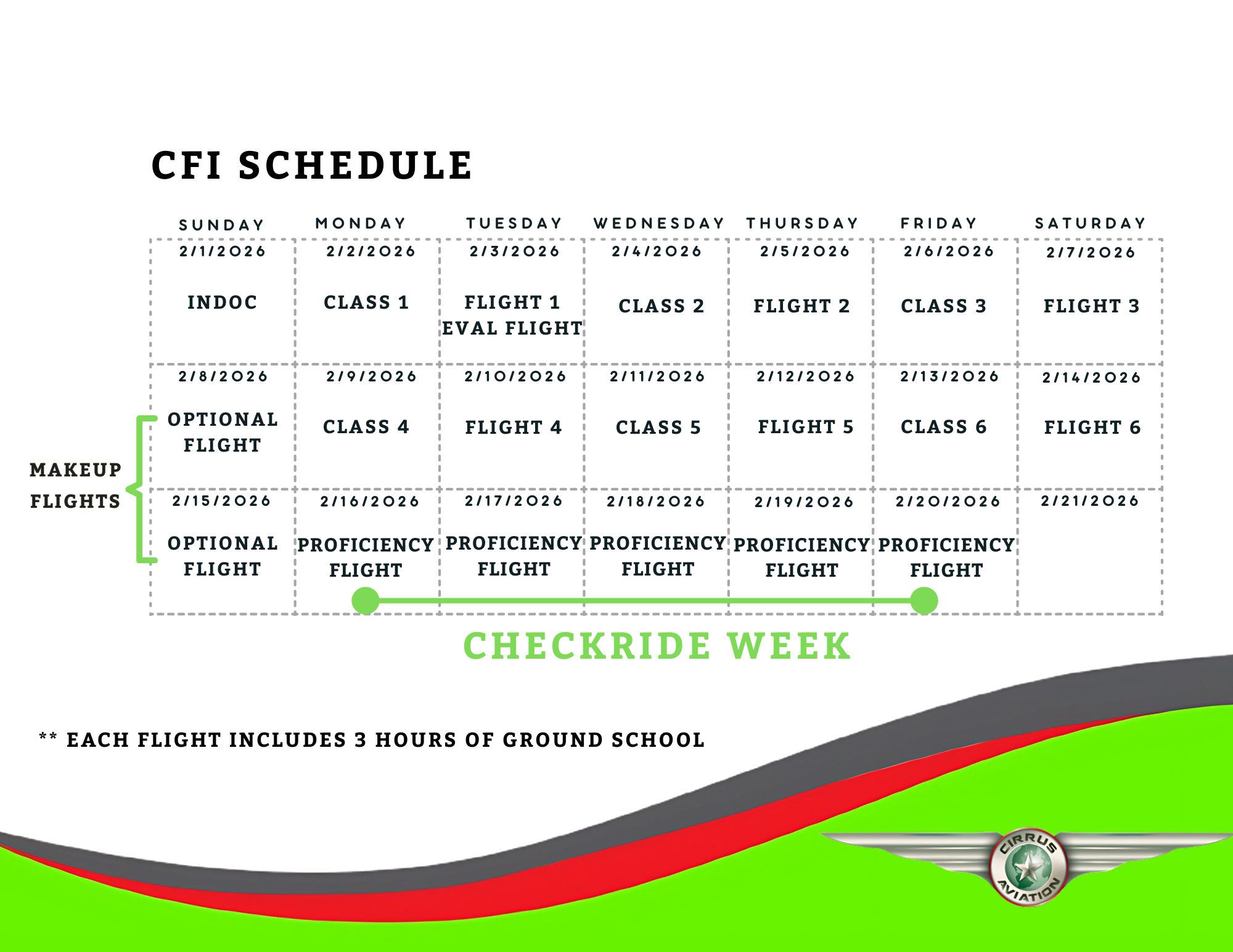
Available February 1 – February 14
CFI IFR Ground School Overview
This program integrates focused ground instruction with a structured flight syllabus. Classroom sessions build the foundational knowledge required for safe, effective instruction and decision-making, while flight lessons reinforce teaching techniques, performance standards, and maneuver proficiency from the right seat.
Candidates will receive individualized feedback throughout the course, allowing instructors to tailor training to each pilot’s strengths and areas for improvement.
Ground School Curriculum
Class 1: Fundamentals of Instruction
An in-depth review of instructional fundamentals, including learning theory, human behavior, effective teaching techniques, and evaluation methods. This session establishes the framework for how pilots learn and how instructors should structure lessons to maximize retention and performance.
Class 2: Runway Incursions and Airport Operations
Focuses on airport environments, surface operations, signage, markings, lighting systems, and best practices to prevent runway incursions. Emphasis is placed on situational awareness, communication, and instructional strategies for safe ground operations.
Class 3: Risk Management & Aeromedical Factors (Human Factors)
Covers aeromedical decision-making, physiological and psychological considerations, and FAA risk management models. Candidates learn how to identify hazards, mitigate risk, and teach sound aeronautical decision-making (ADM) to students.
Class 4: Principles of Flight, Aircraft Flight Controls, Aircraft Systems
A technical review of aerodynamics, aircraft control systems, and major aircraft systems. Candidates learn how to explain complex concepts clearly and accurately at the student level while maintaining technical precision.
Class 5: Airspace, Night Operations, Regulations, and Endorsements
Detailed instruction on airspace classifications, operating requirements, night flight considerations, FARs, and required endorsements. Emphasis is placed on regulatory compliance and teaching regulatory knowledge effectively.
Class 6: Cross-Country Training and Aircraft Performance
Covers cross-country planning, navigation techniques, performance calculations, weight and balance, and operational limitations. Candidates learn to integrate planning concepts with real-world instructional scenarios.
Flight Training Syllabus
Flight 1: Evaluation Flight
Candidates perform all Private Pilot (PPL) and Commercial Pilot (CPL) maneuvers from the right seat. The instructor evaluates technique and knowledge. Following the flight, the instructor provides a detailed critique and develops a customized training plan to address identified deficiencies. New CFI-level maneuvers may be introduced as appropriate.
Flight 2: Introduction to CFI Maneuvers & Deficiency Review
Candidates revisit maneuvers identified as deficient during the evaluation flight and implement the tailored improvement plan. Additional CFI maneuvers are introduced. Candidates are expected to operate using standard operating procedures (SOPs) with minimal instructor input.
Flight 3: Emergencies and Ground Reference Maneuvers
Focuses on teaching flight by reference to instruments during departure, unusual attitudes, and emergency procedures. Instructors simulate emergency scenarios, requiring candidates to teach appropriate pilot responses. All ground reference maneuvers are performed and evaluated.
Flight 4: Performance Maneuvers
Candidates demonstrate and teach all required performance maneuvers, emphasizing precision, safety, and instructional clarity.
Flight 5: Landings and Traffic Pattern Operations
Candidates perform correct pattern entries at a non-towered airport, manage all radio communications, and execute all landing types, including at least one go-around. Forward slips and low-wing slips to landing are demonstrated and taught.
Flight 6: Final Evaluation Flight
A comprehensive mock checkride in which candidates demonstrate all required maneuvers, teaching techniques, and decision-making skills. This flight is designed to assess readiness for practical testing and real-world instructional responsibilities.

Who This Course Is For
This program is ideal for pilots seeking advanced instructional proficiency, structured evaluation, and scenario-based training in both ground and flight environments. The combination of classroom learning and tailored flight instruction ensures candidates leave confident, competent, and prepared for the next stage of their aviation career.